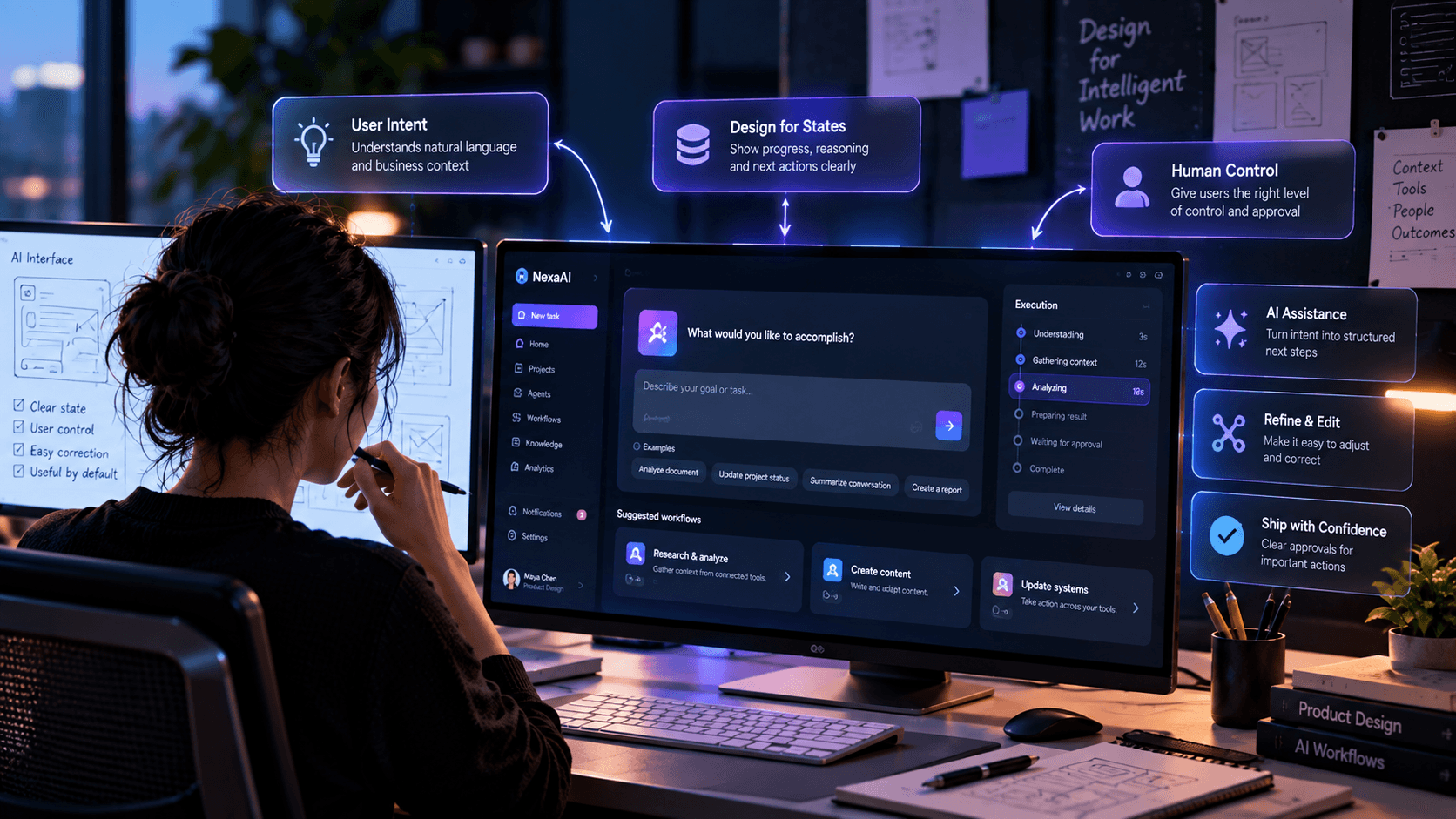
The interesting shift in AI is not simply that models can produce better answers. It is that software can increasingly understand an objective, gather context, use tools and move work forward across several steps.
Agents need clear boundaries, not unlimited autonomy.
Tools and context matter as much as the model itself.
The strongest agent workflows make progress visible.
01 · The shift
Moving beyond the chat box
Most early AI experiences were built around a simple interaction: a person asks a question and the model returns an answer. That interface remains useful, but it leaves the human responsible for every step that follows.
An agent changes that relationship. Instead of stopping at a recommendation, the system can work toward an objective through a sequence of observable actions. It can gather information, select an available tool, update a system, request approval and continue after receiving new context.
Understand an explicit objective
Gather the context needed for the task
Choose from approved tools
Perform bounded actions
Verify results before continuing
02 · Architecture
Design the execution loop before the personality
Teams often begin agent design by deciding how an agent should sound. Tone matters, but execution design matters more. A useful agent needs a clear path from an incoming objective to a finished outcome.
That path should make state visible. The product should show what the agent is currently doing, which tool it is using, whether an action succeeded and where human intervention is required.
A practical execution model
Objective
Context
Plan
Tool action
Validation
Outcome
03 · Context
The model is only one part of the system
A capable model without useful context still produces limited outcomes. Business agents become more valuable when they can safely access the systems where work already lives.
That can include project data, customer records, documents, messages, analytics or internal APIs. Access should remain scoped to the specific responsibility of the agent rather than exposing an entire company environment by default.
Give each agent only the context it needs
Separate read permissions from write permissions
Make sensitive actions explicit
Keep important actions inspectable
04 · Control
Autonomy should increase with confidence
Not every action carries the same level of risk. Summarizing a document is fundamentally different from issuing a refund, changing a production setting or contacting a customer.
A mature agent system uses different control levels. Low-risk actions can happen automatically, uncertain actions can request review and high-impact actions can require explicit approval before execution.
Good human-in-the-loop design does not place approval everywhere. It places approval exactly where judgment, risk or accountability makes it valuable.
05 · Measurement
Measure completed outcomes, not impressive demos
Agent demos can look convincing while still failing to create meaningful operational value. The better measurement is whether the system consistently completes useful work.
Track successful executions, failed actions, human intervention, time saved and the quality of the final outcome. Those signals tell you whether the agent is becoming a dependable part of the workflow.
Successful task completion
Average execution time
Approval and escalation rate
Recovery from failed actions
Business outcome produced
“The useful question is no longer only what AI can answer. It is what work AI can responsibly move forward.”
NuvoraAI Editorial
In practice
Key takeaways
Start with a narrow responsibility and expand carefully.
Design the execution state so people can understand what is happening.
Treat permissions and approvals as product features.
Judge an agent by completed work, not conversation quality alone.
Written by
Maya Chen
Product Strategy · NuvoraAI