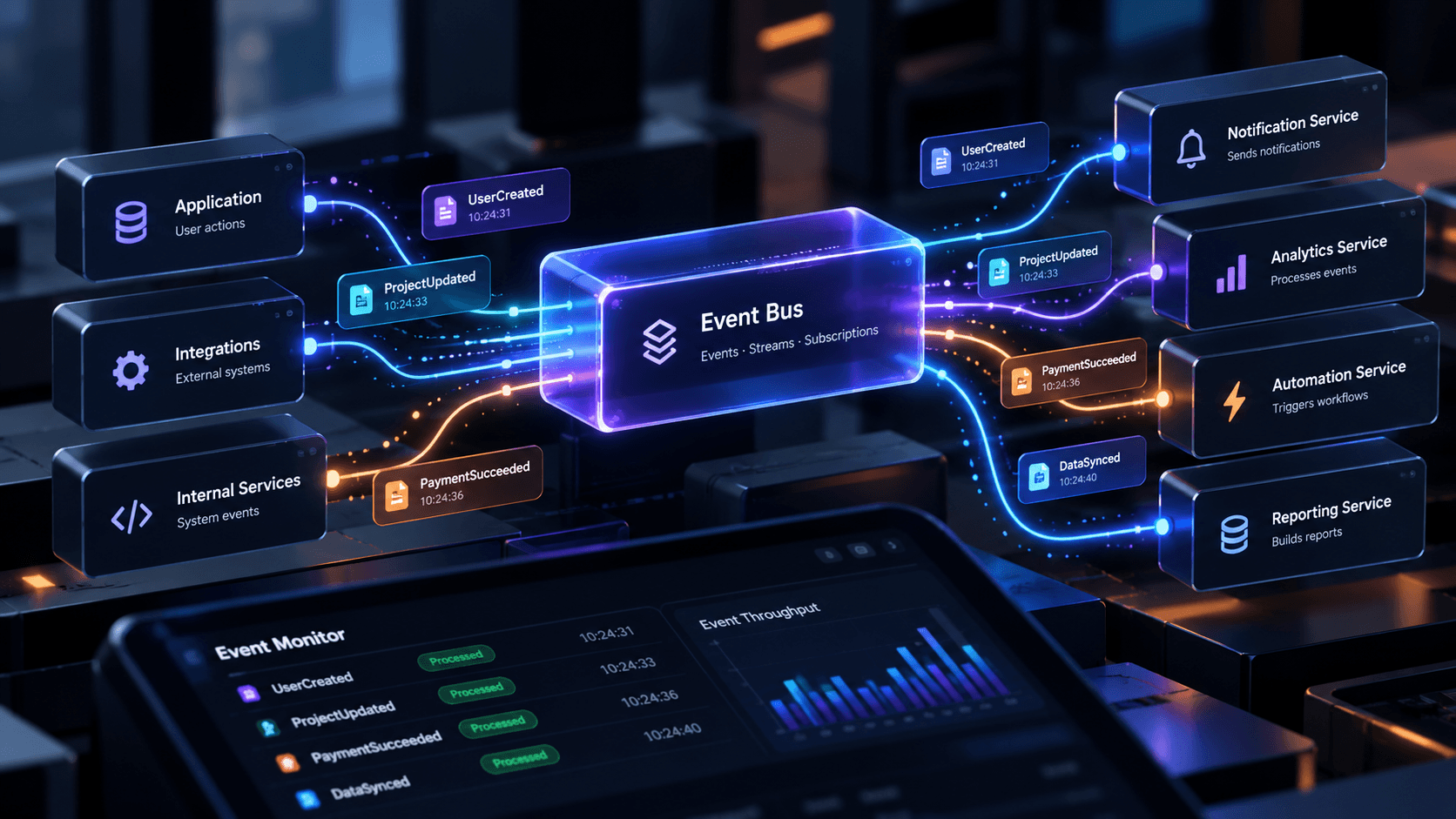
Event-driven architecture gives software a structured way to react when meaningful changes happen across a product or connected system.
Events represent meaningful changes in state.
Consumers should remain independently scalable.
Reliability requires retries and idempotency.
01 · Foundation
Start with meaningful domain events
An event should describe something the system cares about: a subscription activated, a project completed or an approval rejected.
Clear event naming makes downstream integrations easier to reason about and maintain.
Example event path
Event created
Published
Consumed
Action executed
Acknowledged
02 · Architecture
Separate the event from the reaction
The service producing an event should not need deep knowledge of every consumer that reacts to it.
That separation allows new automation and analytics consumers to be introduced without constantly modifying the original service.
03 · Reliability
Design for duplicate and failed delivery
Distributed systems eventually experience retries, timeouts and partial failure. Consumers should expect events to arrive more than once.
Idempotent processing, retry policies and dead-letter handling make event systems much more dependable.
“Events become powerful when they describe what happened without requiring the producer to understand every downstream reaction.”
NuvoraAI Engineering
In practice
Key takeaways
Model events around business meaning.
Keep producers and consumers decoupled.
Expect retries and duplicates.
Written by
Marcus Reed
Engineering · NuvoraAI